

Finding cheap health insurance for your move to Spain can be tempting. But when the policy is being used for a visa or residence application, the lowest price isn't always the best deal.
Two policies can look similar on the surface while offering very different levels of coverage. The price difference usually comes down to specific features — such as coverage limits, waiting periods, copayments, geographic coverage, or the size of the medical network.
Understanding those differences before you buy can help you avoid an unpleasant surprise at your visa appointment or after you arrive in Spain.
Where the Price Difference Usually Comes From
Insurers don't lower prices by cutting a random 30%. The savings show up in a small number of predictable places:
- It's actually travel insurance with coverage limits. Spain's visa insurance requirement calls for 100% coverage of medical, hospital, and outpatient costs — no coverage caps. A travel-insurance-style product often comes with a limit (say, €30,000) instead of unlimited coverage. That limit alone can disqualify it, even if everything else about the policy looks reasonable.
- It includes copayments or a waiting period. The requirement is explicitly sin copago, sin carencia — no per-visit charges, no delay before coverage kicks in. A cheaper plan that still makes you pay a percentage per visit, or wait a few months before certain treatments are covered, doesn't meet the bar regardless of price.
Here's the part most people miss: no-copay is easy to be complaint for — plenty of budget plans advertise it front and center. No waiting period is a different story. Very few agents actually know how to secure a policy that's genuinely carencia-free, and it shows: many quietly steer the conversation toward the copay question and let the waiting period slide by unmentioned.
Here's an example of a client who purchased insurance that did not meet the sin copago, sin carencia requirements. This was detected by the immigration authorities, and the client was left scrambling to find a new, compliant policy at short notice.
 (1).png)
- Geographic scope. Some "insurance for foreigners" products are built for a specific city or region, not the whole country. One well-known foreigner-focused health insurance product, for example, is explicitly marketed as coverage for people who live in the province of Barcelona — rather than as a nationwide product. Even if that product's own marketing describes itself as meeting visa requirements, that claim only holds for someone actually settling within its covered area. It doesn't extend to an applicant living or applying from anywhere else in Spain.
This is an example of a real requerimiento letter from Extranjería, submitted by one of our clients, explicitly requesting a policy with nationwide coverage.

-
How the health declaration is handled. This is the one that costs people the most, and it deserves a direct warning: some insurance agents tell clients that a pre-existing condition can simply be left undeclared and excluded, in order to get a cheaper quote. This is not legal. Under Article 10 of the Ley de Contrato de Seguro, you're required to declare a pre-existing condition before signing — regardless of whether it ends up excluded from coverage, and regardless of whether you ever plan to use the policy for it. Skipping the declaration to save money doesn't just risk your coverage; it can get the entire policy cancelled as fraud once discovered, which puts your certificate — and your visa — at risk too.
Here's what puts the price in perspective. Without insurance, a specialist consultation in Spain runs about €60–120. A private hospital delivery is €6,000–10,000+ for a natural birth, €9,000–15,000+ for a C-section. Neonatal ICU care, if a baby needs it, is billed per day — typically €1,000–3,000 a day. Against numbers like these, a policy that actually covers your health history properly, instead of quietly excluding it to look cheaper, isn't the expensive option. It's the one priced for what care in Spain actually costs.
We cover the legal side of this in full — including what "sin exclusiones" means for consulate requirements — in our article on sin exclusiones and Article 10. If you take one thing from this list, take this one.
-
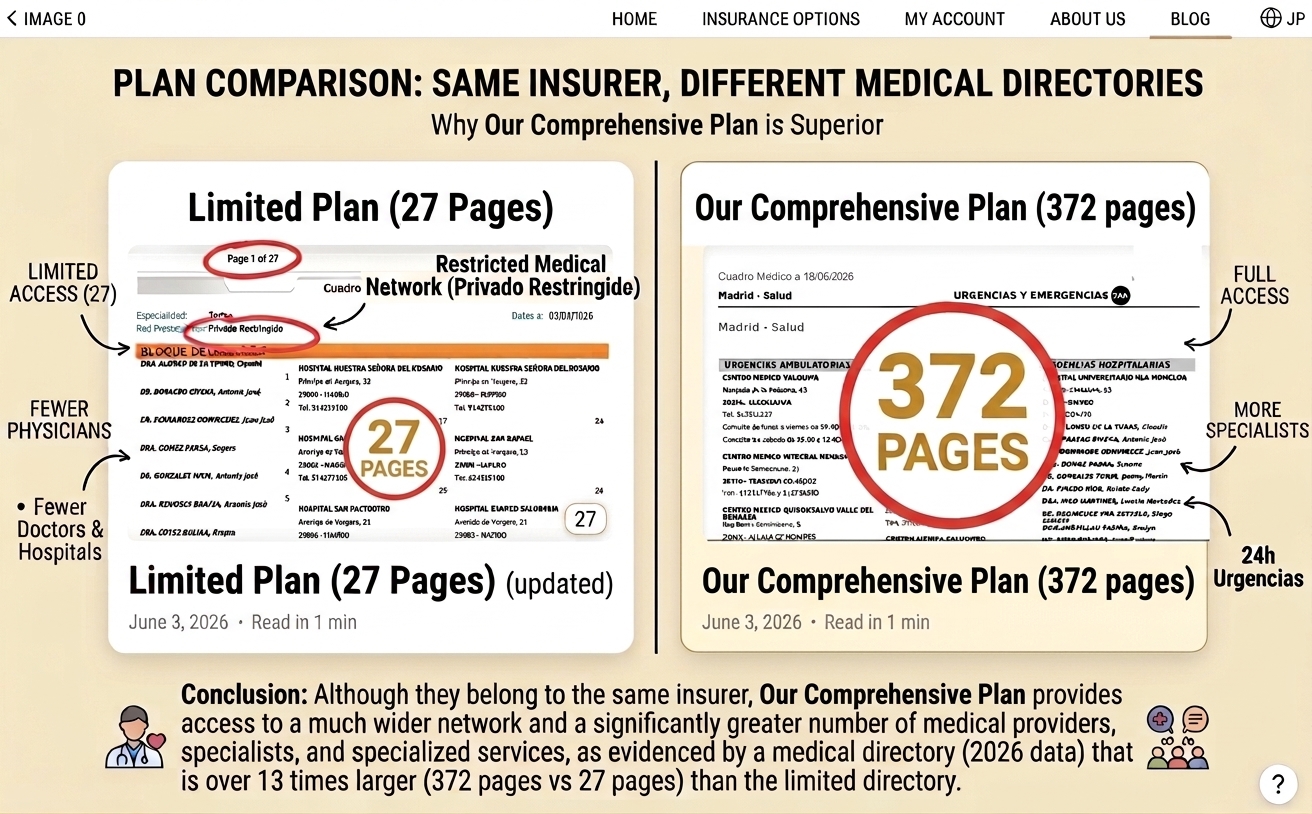
Network size. Fewer partner hospitals and clinics, which affects your day-to-day access more than your visa application, but affects both.
Here's an example worth paying attention to: on the surface, these two plans look identical — same insurer, same product name, same network. But dive into the actual medical network behind each one, and the picture changes: the number of hospitals covered, the quality of those hospitals, and the number and quality of specialists available can differ significantly, as the comparison below shows.
What to Check Before You Buy Based on Price Alone
| Check | Why It Matters |
|---|---|
| Does the policy have a coverage cap, or is it 100%, no limit? | A capped policy is a travel-insurance structure, not a visa-compliant one, regardless of what it's marketed as. |
| Are there any copayments or waiting periods? | Both disqualify a policy outright — "sin copago, sin carencia" is a strict, not approximate, standard. |
| Is the coverage nationwide, or limited to a specific city/province? | Visa insurance generally needs to be valid across all of Spain, not just where the insurer is based. |
| Does the certificate say "sin copago" and "sin carencia" explicitly? | This is the exact phrase consulates and visa centers check for — general "comprehensive coverage" language isn't the same thing. |
| How is your health declaration being handled? | If an agent suggests skipping or excluding without declaring, stop — this is the single most common way a cheap policy turns into a bigger problem later. |
| Is repatriation coverage included? | This is one of the requirements that many people overlook. |
The Real Trade-Off
Apart from being a product that does not fulfill the visa requirements, being offered a price that’s dramatically below the market range on a product marketed specifically at visa applicants is usually buying you something narrower: a coverage cap, a smaller region, a smaller network, or — most seriously — a shortcut on the health declaration that doesn’t show up as a problem until it’s checked.
What Innoinsure Does Differently
Every item on this list is a place where a resold or budget certificate can quietly fall short — a cap instead of full coverage, a region instead of nationwide validity, a skipped declaration instead of a properly handled one. Innoinsure issues policies directly as the official licensed office of established Spanish insurers, built around the full requirement from the start: no coverage caps, no copayments or waiting periods, nationwide validity, and a declaration process that’s handled correctly rather than shortcut.
At Innoinsure, we understand that choosing health insurance for a move to Spain isn't simply about finding the lowest monthly premium.
It's about finding a policy that fits your visa requirements and gives you appropriate private healthcare coverage once you're in Spain.
We help applicants understand the important details before they purchase — from copayments and waiting periods to geographic coverage, medical networks, and the documentation required for their application.
If you’re not sure whether a quote you already have checks out, contact us before your appointment — not after a rejection, or a sudden requerimiento.
FAQ
Q: How do I know if a policy is nationwide or regional?
A: Check the certificate and the insurer's own product description directly — nationwide validity should be stated explicitly, not assumed from the brand name.
Q: An agent told me I could exclude a pre-existing condition instead of declaring it to save money. Is that fine?
A: No — this is one of the most common and most serious mistakes applicants get talked into. See our full breakdown of why this isn't legal and what it puts at risk.
Q: Is it worth paying more just for visa purposes?
A: If the cheaper option doesn't meet the specific wording and scope requirements, the "savings" disappear the moment the certificate gets rejected and you have to buy a second policy anyway.
Protect your stay in Spain with expat insurance
Get expat insurance