

Two people can hold insurance from the exact same company and still get very different experiences in practice. One walks into a major private hospital and gets seen right away. The other gets turned away — that hospital simply isn't in their network.
The insurer's name on the policy doesn't tell you which hospitals you can actually use. The specific plan you bought does.
A Real Example: Same Insurer, Two Different Networks
Major Spanish insurers commonly can sell two types of different plans under the same brand name.
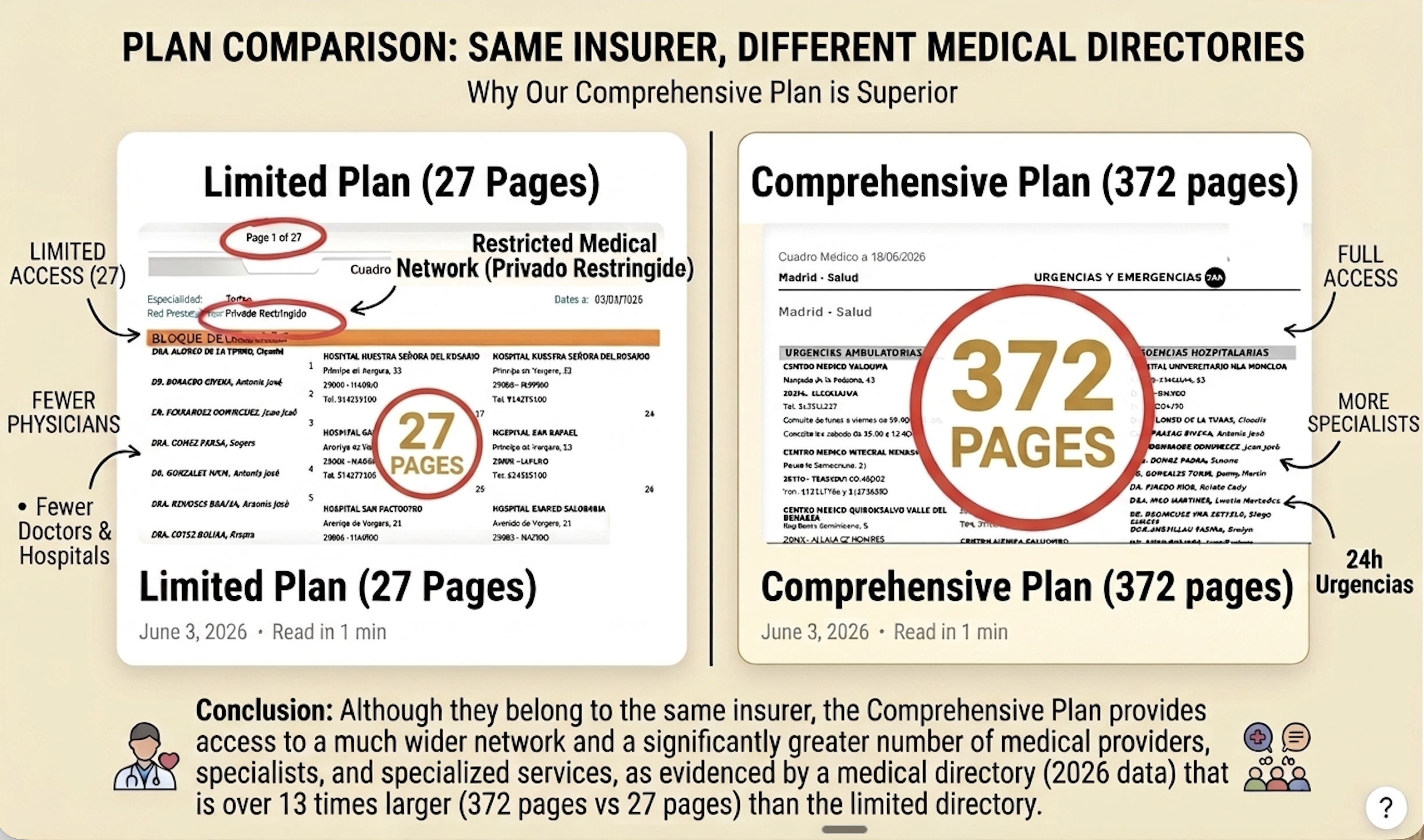
One type of plans is a lower-tier product, priced to catch attention, built on a limited medical network. The other is the full-quality product, built on the insurer's complete network. The two plans can draw on entirely different sets of hospitals. The lower-tier version product relies on a secondary, smaller hospital group, filled in by the insurer's own centers only where that group has no coverage. The other gets the insurer's full national network.
Here's an example worth paying attention to: the two plans below look like the product if you don´t dive deeper into the real medical network, you will realize that the number of hospitals covered, the quality of those hospitals, and the number and quality of specialists available under each plan can differ significantly, as the comparison below shows.

What a Narrow Network Actually Looks Like in Practice
This isn't just "fewer hospitals" in the abstract, and it isn't random which hospitals get cut. Budget plans don't shrink the network by trimming a bit off everywhere — they cut the expensive part first, which is usually also the good part:
- Fewer hospitals overall. The ones that remain tend to be public-private joint facilities rather than dedicated, higher-cost private centers.
- The specific hospitals cut tend to be the higher-quality, higher-cost ones. Spain's most well-regarded private hospital groups — names like Quirónsalud, HM, Vithas and other major networks — charge insurers more to include, so they're the first thing dropped from a lower-priced plan, not a random selection. These groups are typically only included in fuller, higher-tier plans.
- Fewer doctors per specialty. The more experienced doctors are often the first to go. A specialty can technically still be "covered" on paper while in practice you're offered a single junior doctor or a long waiting list — because the higher-demand specialists are attached to the hospitals that got cut.
So the reduction isn't just about size. It specifically targets quality and cost, not just the number of options. The result is a real gap between "I have insurance" and "I have the level of care a fully compliant plan should actually provide." Only the latter has real, private-first access to quality care.
It's Not Just the Network — What Else Usually Gets Cut
A narrow cuadro médico is rarely the only thing a budget visa-focused plan trims. These products are typically marketed as meeting Spain's visa insurance requirements, and technically they often do cover the two most well-known parts of that requirement — sin copago, sin carencia.
What they frequently cut are the requirements that get less attention but are just as mandatory: repatriation coverage and a plan that fulfills the no exclusions rules on pre-existing conditions.
If you're comparing a narrow-network, budget-priced plan, the small network is the problem you can see. The one you can't see is just as important to check: does the plan actually include repatriation? Does it cover pre-existing conditions without exclusions? Sin copago and sin carencia alone don't answer either question.
What to Actually Check Before You Buy
- Check repatriation and pre-existing condition handling specifically — don't assume a plan is fully compliant just because it advertises sin copago and sin carencia.
- Ask directly whether the plan you're being quoted includes the insurer's full network, or a reduced one — this is a fair, normal question, and a legitimate insurance office should be able to answer it plainly.
- Check how substantial the network list actually is — whether it spans real hospitals and a genuine range of specialties, or is padded with repetitive center names to look longer and more comprehensive than it actually is.
What Innoinsure's Network Actually Covers: Buy the Plan, Not Just the Brand
If you're not sure whether your quote includes a full network or a reduced one — or whether it actually covers repatriation and pre-existing conditions the way sin exclusiones requires? It's worth having it checked before you commit.
Before buying Spain visa insurance, check both visa compliance and the medical network included in your specific policy.
If you're comparing two plans and aren't sure what the difference is, Innoinsure can help you understand what each plan actually provides before you buy.
Innoinsure can walk you through exactly what a specific plan does and doesn't include before you buy.
FAQ
Q: If I have insurance from a well-known Spanish insurer, doesn't that guarantee full hospital access?
A: No — the brand name guarantees the insurer is real and licensed, not which specific hospitals your particular plan includes. That depends on the plan tier.
Q: How do I check which hospitals my policy actually covers?
A: Use the insurer's own cuadro médico search tool with your specific city and the hospital name — don't rely on general brand reputation.
Q: Can I access hospitals like Quirónsalud or HM with any visa-compliant policy?
A: Only if your specific plan's network includes them — this varies by plan tier even within the same insurer, so check the actual cuadro médico rather than assuming.
Protect your stay in Spain with expat insurance
Get expat insurance