

Don't Buy Insurance Based on a Story You Heard
A successful application doesn't automatically mean that the policy was suitable for every visa applicant or that the same policy will meet the requirements of your application.
Some applicants assume that if a policy gets through the visa process once, it must have been fine. It's a natural assumption, but it's the wrong one. Approval at the time of application checks whether a certificate was submitted — it doesn't retroactively confirm the underlying policy was actually compliant, and it doesn't make a real gap in that policy disappear.
What Actually Happens When the Bet Doesn't Pay Off
Sometimes it doesn't take years for a gap like that to surface — it happens right away. We regularly hear from clients who bought a policy from another provider, only to have their application flagged because that policy wasn't actually compliant. When that happens, the applicant is typically given a short window — often around 10 days — to submit a fully compliant policy and the correct documentation, or the application is rejected for lack of it.
Ten days is quite little time to find a genuinely compliant policy, get it issued correctly, and receive a certificate that actually holds up. It's stressful and rushed under the best circumstances. It gets worse because of what happens with the first policy: the non-compliant insurer very often won't refund it. Even if the application was rejected because of their policy. Even if they told the applicant they'd refund it. Some of these companies simply stop responding once the money has already changed hands. The applicant is left buying a second policy under time pressure, without getting the first payment back — which is a meaningfully worse position than just paying for the right policy from the start.
Where an Unresolved Gap Can Resurface
This isn't a one-time risk tied to a single appointment. A gap that isn't addressed at the time of purchase can come back into view at several points down the line:
If the authorities identify a problem with your insurance documentation, you may receive a requerimiento.
A requerimiento is simply a request from a Spanish authority asking you to provide additional documents or information.
- A closer review triggered by something unrelated. A case that draws extra scrutiny for any reason can end up with every document, including older insurance certificates, which might be examined more carefully than they were originally.
- Renewals. At the 2-year mark, the 5-year mark, or when applying for larga duración residency, immigration authorities review your insurance history as a whole — not just your current policy. An unresolved gap from years earlier doesn't stay buried; it can surface at exactly the point when there's no longer any way to go back and fix it.
- The moment you actually need the policy. A real gap in coverage — an undeclared condition, an exclusion, missing repatriation — doesn't matter for paperwork purposes until it matters for your health. That's the worst possible time to find out a policy doesn't hold up.
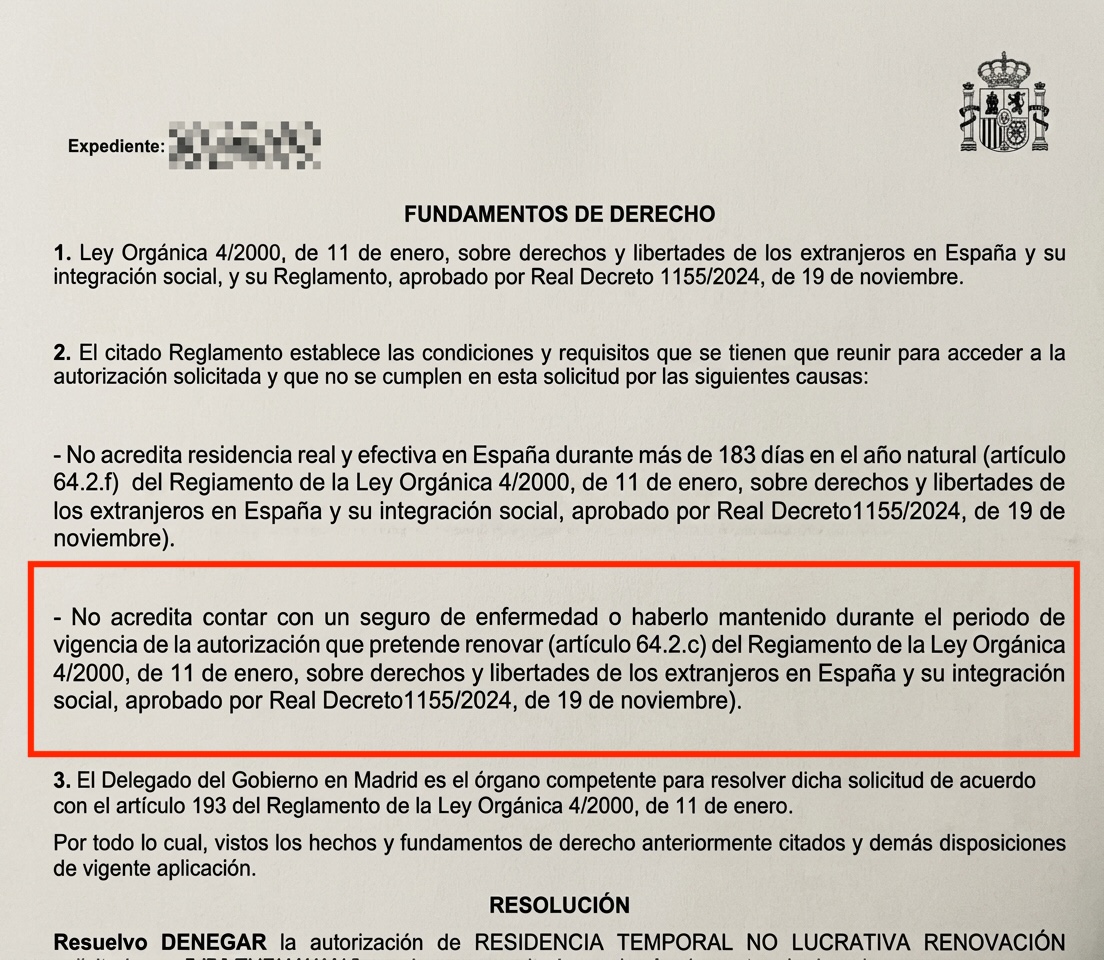
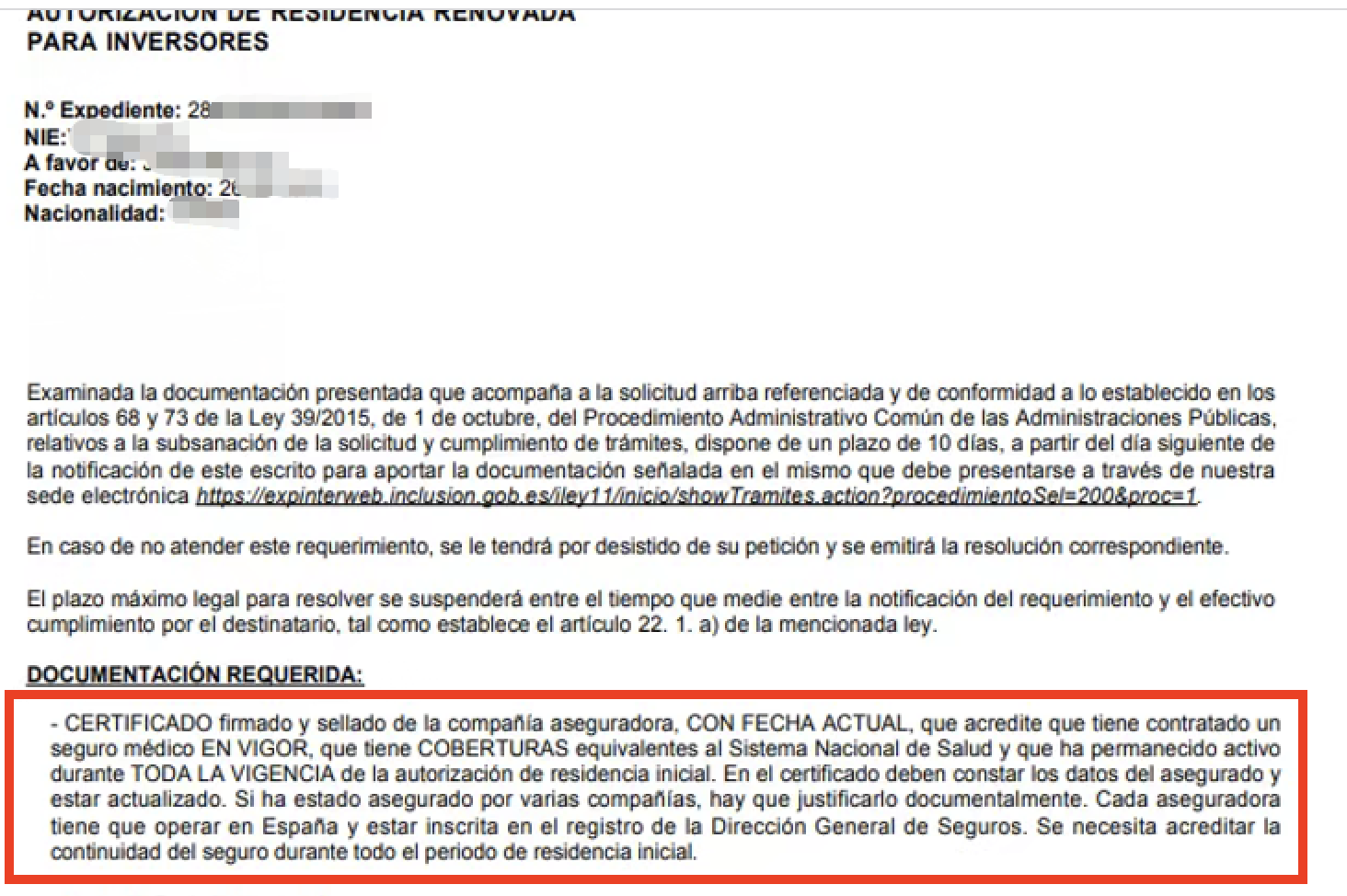
Here are two examples of rejection or requerimiento letter we received from two clients, whose visa renewal received notices due to a lack of proof of compliant insurance coverage during a previous period. This gap was detected by Extranjería, and the clients were required to provide evidence covering that period.
When this happens, if the client can't provide proof of having held compliant insurance for that specific period, there's often no way to fix it after the fact — insurance companies may not accept a retroactive alta (backdated enrollment) to cover a gap that's already passed.
- Example of a document where the client did not submit health insurance document in a certain period of time before the renewal. Lack of this document and other lack of compliance has resulted in a rejection result.

- This is an example of a real requerimiento letter, provided by one of our clients, asking for proof — dated to the present — that the policy is still active. Extranjería asks for this specifically to catch cases where a policy was purchased to apply for the visa and then cancelled shortly after.

What Innoinsure Does Differently
To be direct about what that actually means for you if you buy from us instead of gambling on a story:
- Every plan we issue is verified against the real requirements, backed by years of first-hand experience of actual approvals — sin copago, sin carencia, full coverage, no coverage caps, nationwide validity, repatriation included, and pre-existing conditions declared and handled the way sin exclusiones requires. Not the shortened, well-known-only version of the requirement.
- We work directly with Spain visa center network, as a company included in their recommendations, which is how we issue and stand behind our certificates.
- If a consulate needs more than the standard certificate, that happens more often now than it used to, since documentation requirements have gotten stricter. When a consulate wants direct confirmation from the insurance provider, or additional supporting proof, we can provide that — or contact the consulate directly — rather than leaving you to handle it alone.
The Bottom Line
“It worked for my friend” isn't the same as “it meets the requirements for me.”
When choosing Spain visa insurance, don't rely only on recommendations, Facebook groups, or someone else's experience.
Check the actual policy.
Check the requirements for your visa.
And make sure you can provide the right documentation if the authorities ask for it.
If you're unsure about an insurance quote, ask before you buy — not after you receive a requerimiento.
Innoinsure can help you understand your options before you submit your application.
This is a real example of a requerimiento letter we got from a client, requiring the insurance company to provide a secure verification code or a verifiable electronic signature confirming the certificate's authenticity. Our team responded quickly and provided the required documentation to the client in time. As a professional insurance office, we work with immigration legal professionals to stay updated on all current immigration requirements and news.
.png)
.png)
FAQ
Q: What happens if my visa application is rejected even with a compliant policy?
A: With Innoinsure, the months of coverage that haven't started yet are refunded — you're not left paying for coverage tied to a visa that didn't go through.
Q: What should I do if I already bought a non-compliant policy and got flagged?
A: Move quickly — you're usually working with a short window. Get a fully compliant policy and correct certificate as soon as possible, and separately try to recover what you can from the original insurer, though don't count on that refund actually happening.
Q: If my policy already got approved, does that mean it's compliant?
A: Not necessarily. Approval confirms a certificate was submitted and accepted at that moment — it doesn't confirm every part of the underlying policy was actually reviewed closely enough to catch a real gap.
Q: Why would an already-approved policy cause a problem later?
A: Renewals and longer-term residency applications involve a review of your full insurance history, not just your current policy. An unresolved gap from years earlier can resurface at that point, when it's too late to fix retroactively.
Q: What makes a policy "verified" rather than just advertised as compliant?
A: It should cover the full requirement, not just the two most well-known parts (sin copago, sin carencia) — including repatriation and proper handling of pre-existing conditions — and come from an insurer or office that can back it up if a consulate asks follow-up questions.
An unresolved gap doesn't announce itself. Talk to Innoinsure before you submit — we'll tell you plainly whether a policy is actually built to hold up, not just whether it might get through.
Protect your stay in Spain with expat insurance
Get expat insurance